
Kip Ping, PE, SE — Principal and Founder, Pinnacle Engineering
Over the past few years, we’ve been getting more calls about barndominiums than ever before, from homeowners, contractors, and architects.
There’s a lot of information out there on the topic. Some of it is solid. Some of it is incorrect and even misleading.
Here’s my review after working on these projects. Barndominiums can be a smart choice, but the cost advantage that makes them appealing is easier to lose than most people realize.
What Is a Barndominium?
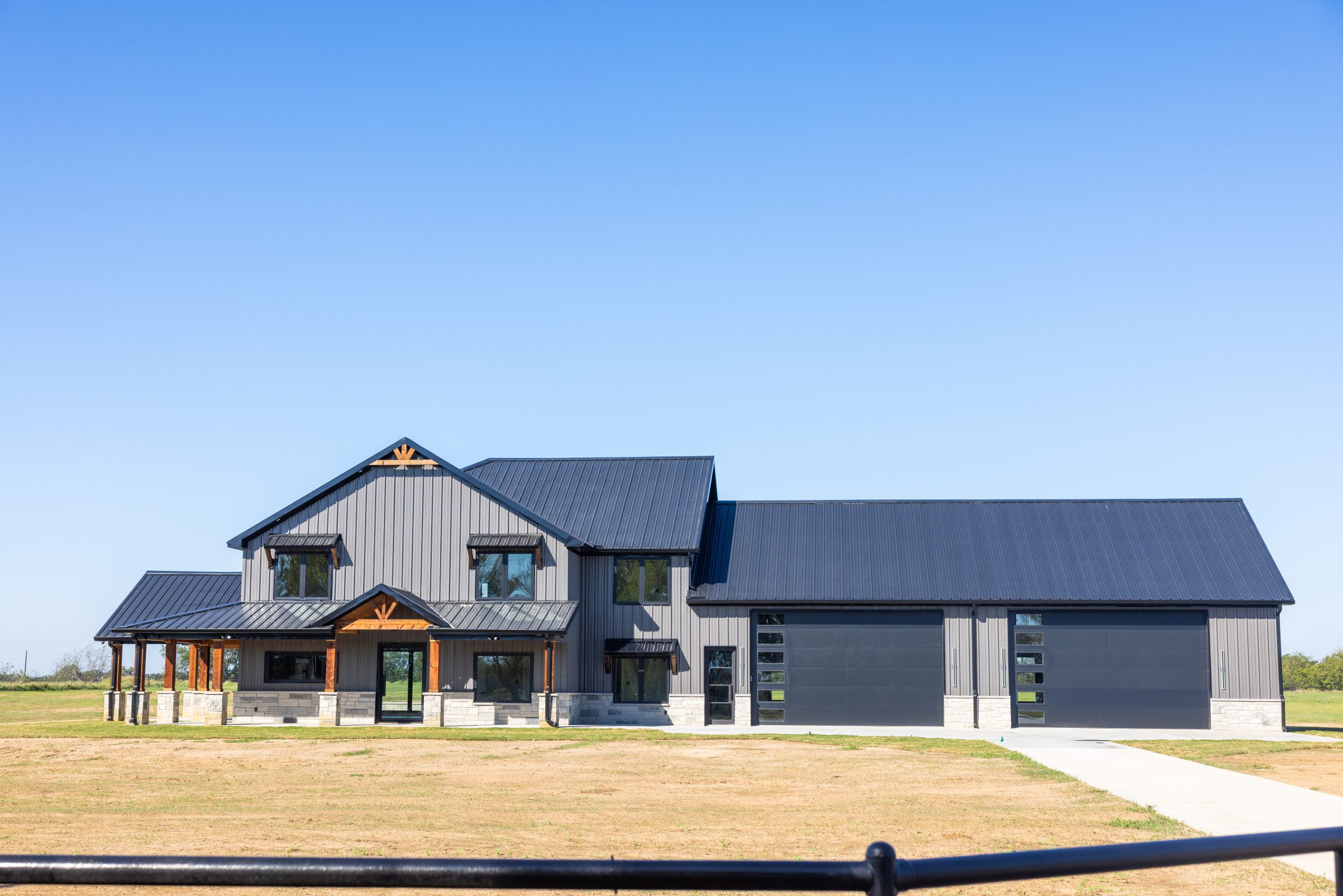
A barndominium is a home that uses a wood post-frame building, sometimes called a pole barn, as its main structure. More recently, pre-fabricated metal buildings have also been used for this purpose.
The original appeal was straightforward: homeowners wanted large open spaces with a residence attached. Since post-frame buildings are economical and commonly used for barns, garages, and shops, using this structural system for residential purposes was a natural evolution.
A traditional barndominium includes a living area sized like a small apartment, with the remainder of the building dedicated to another use. However, we are now also seeing cases where the entire structure serves as the home.
How are Barndominiums Constructed?
Understanding the structural system matters because it directly affects whether a barndominium is the right solution for your project. This varies depending on whether the building uses wood-post frame construction or pre-fabricated construction.
In a typical wood post-frame building, posts are embedded in sockets drilled about 4 to 5 feet into the ground, bearing on a small precast concrete pad, referred to in the industry as a “cookie”, or a site-cast concrete footing. Posts are spaced approximately 8feet on center and cantilever up to the eave. A wood carrier beam is attached to each side of the posts at the eave, and wood girts (horizontal wall beams) run between the columns. Corrugated metal siding attaches to the girts.
Engineered wood roof trusses are spaced four feet on center and placed on top of the carrier beams to clear-span the building. Horizontal roof beams called purlins are spaced at 24 inches on center and span between the trusses. Corrugated metal roofing attaches to the purlins.
Pre-fabricated metal buildings follow a similar layout but use all-metal construction and sit on a slab-on-ground foundation. Steel frames, or “bents”, are spaced approximately four feet on center with metal girts, purlins, and siding arranged in the same general pattern as the wood version.
What Is The Benefit of Choosing a Barndominium?
For the right project, a barndominium can be a great option. The primary advantage is cost.
For a basic shell, a barndominium can cost around $80 per square foot, compared to roughly $150 per square foot for a traditional builder home and $300 per square foot for a luxury home.
For a 2,000-square-foot home, the barndominium costs approximately $160,000, versus $300,000 for a builder home.
Other benefits are sometimes cited, such as open floor plans, but they are readily achievable in other construction types as well and are not unique to barndominiums.
Economy is the defining advantage. Which brings us to the question of when that advantage starts to erode.
Why Barndominiums Might Not Be The Best Choice For Your Project
The most common reason a barndominium stops making financial sense is when the modifications required to make it function as a home start stacking up. Each change adds cost and chips away at the original price advantage. Here are the most frequent structural construction modifications we see that require additional cost:
- Exterior wall framing: Wood stud walls are typically installed within exterior walls to provide insulation and run electrical and plumbing. These are the same walls used in traditional construction, so at this point, the barndominium essentially has a conventional wall system inside a post-frame shell.
- Ceiling Framing: Drywall ceilings must attach to framing members no more than 24 inches on center. Standard post-frame trusses are spaced at 48 inches on center, so either the number of trusses must be doubled, or additional furring must be added to the underside of the trusses. A lay-in ceiling or exposed ceiling can avoid this issue, but comes with its own trade-offs and isn’t a ceiling most homeowners want..
- Truss Capacity: Post-frame trusses are typically designed to carry only roof loads. Once the building becomes a residence, the trusses need to be redesigned to handle the added weight of ceilings, lighting, ductwork, and other mechanical systems.
- Exterior Wall Cladding: The exterior wall cladding of a post-frame building is typically metal siding. As with the walls, some homeowners don’t like the corrugated look, and in some communities, zoning requirements and HOA restrictions require other materials.
- Roofing: The same consideration applies to the roof. Corrugated metal roofing is standard, but it is sometimes replaced with asphalt shingles or standing-seam metal roofing due to preference or local requirements. Making that change requires modifications to truss spacing and the addition of wood roof sheathing, both of which add to the overall cost.
Other Factors Worth Considering Before Building a Barndominium
Foundation & Energy Efficiency for Barndomeniums: A post-frame building has no foundation wall, but building code requires one for a single-family residence. This means a foundation wall must be constructed between the wood posts, or the slab on the ground must be turned down. In the latter case, the slab creates a thermal bridge that allows cold air to migrate from the outside into the living space, posing energy-efficiency challenges. Generally, it is difficult to make a barndominium home energy-efficient without substantial construction changes, which adds to the project’s cost.
Home Insurance for Barndominiums: Because barndominiums are still a relatively new construction method, some insurers are hesitant to cover them or charge higher premiums.
Resale Value for Barndominiums: Some sources also report that reselling barndominiums can be more challenging, with location being the most important factor in whether this is true (rural resale is less affected)..
None of these are necessarily deal-breakers, but they are worth factoring into the decision early.
The Bottom Line
The best fit for a barndominium is a homeowner in a rural or semi-rural area who is comfortable with a non-traditional aesthetic and wants a large, open space attached to their home. If the goal is traditional finishes, an urban or suburban setting, a basement, or a second story, the cost advantage largely disappears, and a conventional home is a more practical choice.
A barndominium can be a smart, cost-effective solution when the structural system is used close to its original intent and major modifications are kept to a minimum. As the list of changes grows, so does the cost, and at some point, the economic advantage of the post-frame system begins to erode.
If you are working through a barndominium project and want a structural engineering perspective early in the process, we are glad to help. Reach out to our team here.

One Comment